
Cleveland State University’s Connected Gardens: Workforce Development Through Urban Agriculture
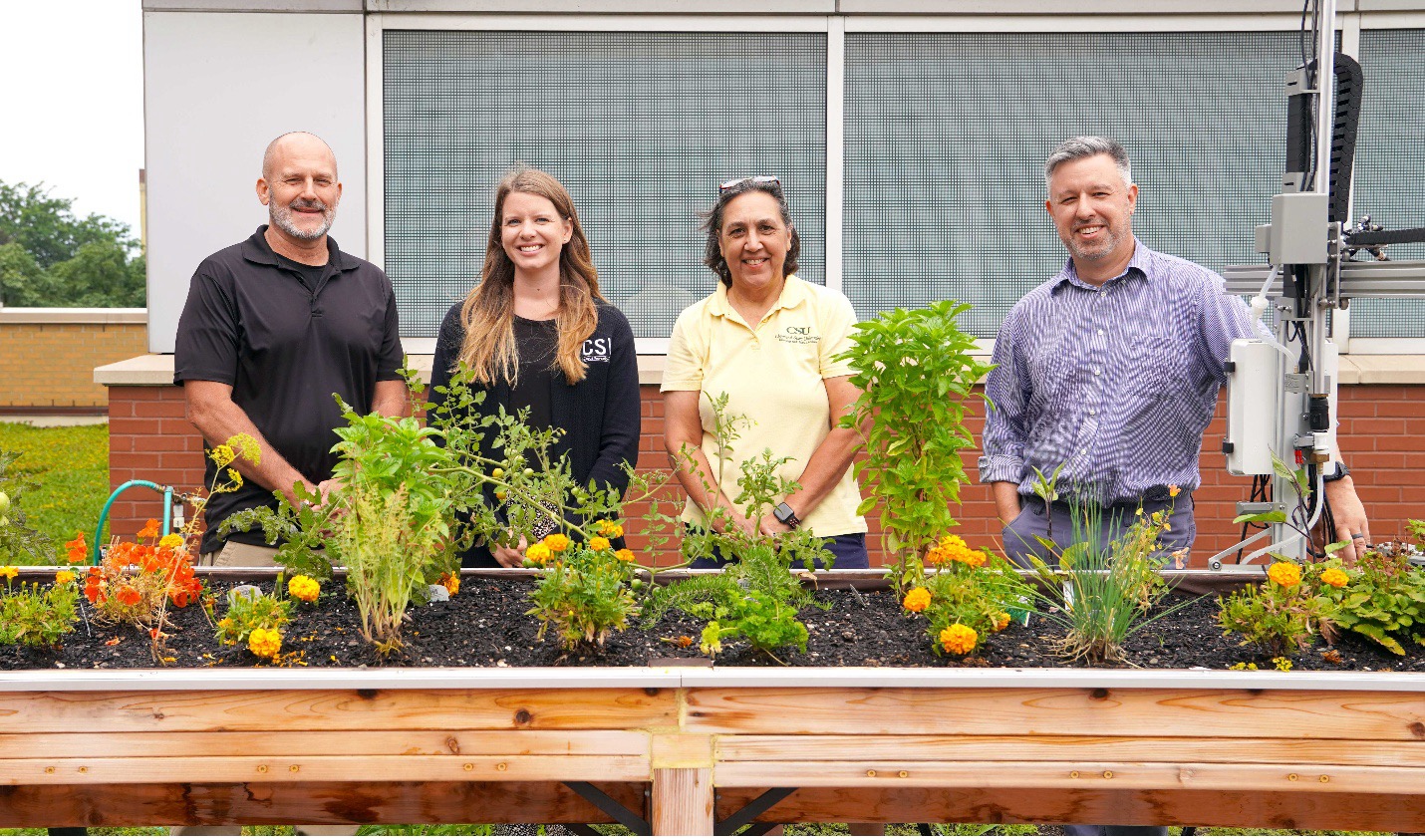
At Cleveland State University (CSU), the Connected Gardens: Urban Sustainability Through Tech initiative is reframing agriculture as a platform for workforce development while giving students hands-on opportunities with cutting-edge tools. An interdepartmental team across Health Sciences, Engineering, Technology, and Campus Operations is using urban agriculture to prepare students for emerging careers in technology, sustainability, and food systems, blending expertise from multiple disciplines into one cohesive learning environment.
The initiative is led by Dr. Judy Ausherman, Professor of Health Education and Master Gardener; Timothy J. Square Jr., Superintendent of Grounds and Motor Pool; Katie Blodorn, Assistant Director for Business Development and University Events; and Christopher Rennison, Director of Academic Technologies in the Office of Instructional Excellence. Together, their expertise spans horticulture, health literacy, technology integration, and student engagement—merging sustainability, STEM, and career readiness into one program.
Reshaping Agricultural Skill Sets
Agriculture is farther ahead with technology than many people realize, and the Connected Gardens initiative is advancing it even more. Timothy J. Square noted that future agricultural workers will need skills in sensor technology, automated systems, GIS, drones, software platforms, irrigation, and harvesting.
“It’s beyond standing out in the field and figuring out what plants need watered,” he said. “Closing the gap between the traditional image of farming and advanced technology can step things up and get newer generations involved.”
For students, that means learning to use sensor networks, map fields with drones, and analyze environmental data to make farming more efficient and sustainable. “It’s becoming data and data-analytical, just like everything else,” Square said.
Square, who studied horticulture at The Ohio State University and grew up around greenhouses in Madison, Ohio, has seen that evolution firsthand. “There were greenhouses I worked in 30 years ago that were temperature, humidity, and carbon controlled. The technology, even 30 years ago, was way ahead of what most people think—but it’s evolving even more, which is just astounding.”
He added that today’s farms can diagnose pest and disease problems through satellite imagery, targeting treatment with drones instead of blanket pesticide applications. “They can narrow it down to specific hotspots and reduce the usage of pesticides, targeting the problem more specifically and efficiently.”
FarmBot and the OSGC SICHOP Grant
In April 2025, CSU’s Connected Gardens team received a Student-Innovative-Creative-Hands-On-Project (SICHOP) grant from the Ohio Space Grant Consortium (OSGC), a STEM-focused consortium managed by the Ohio Aerospace Institute and Parallax Advanced Research, to upgrade CSU’s FarmBot system. The proposal focused on improving the machine’s water sensors and weed detection capabilities.
Mounted on CSU’s rooftop garden, the FarmBot automates tasks like watering, planting, and weeding. With the SICHOP grant, students worked to enhance how the system responds to changing environmental conditions, gaining direct experience in engineering, programming, and troubleshooting.
Rennison described the effort as part of a larger learning arc, explaining that urban agriculture exposes students to observation, hypothesis testing, and analysis. They collect and interpret real data from living systems, then make informed decisions based on their findings.
Learning Through Collaboration
The rooftop garden began as a small herb plot but grew into a campus-wide learning platform with support from CSU’s University Recreation and Wellbeing programs (specifically the Shine Well initiative), along with academic faculty and operations teams.
“When we started this, it was just a small herb garden—something we thought was a cool project,” she said. “And then, through [Dr. Ausherman], it transitioned into a partnership with the School of Engineering.”
Engineering students now program the FarmBot through their Senior Design capstone course, applying classroom knowledge to a working agricultural system.
The produce grown through Connected Gardens also supports food-related programming on campus. CSU’s culinary services team, Viking Food Co., uses the produce in winter cooking demos that show students how to prepare meals in residence halls. In the summer, harvests are donated to CSU’s food pantry, Lift Up Vikes.
“We try to meet students where they are,” Blodorn said. “Even if they don’t see agriculture as a career path, we help them find connections to it—whether through technology, sustainability, or service.”
Square has seen that approach resonate. “Everybody we’ve introduced it to has wanted to get involved somehow,” he said.
The team also works with local partners including Cleveland Root, Rustbelt Riders, and Food Strong. Many contribute materials, soil, or outreach support, and some, like Rustbelt Riders, have CSU alumni involved.
A STEM Ecosystem Rooted in Real Life
Rennison said the rooftop garden offers students a way to explore the full range of STEM disciplines in a real-world setting. “Beginning with science, you can have students exploring plant life cycles, ecosystems, microbiology of soil, pH level, nutrient uptake, water quality, ecology, pollinators, urban biodiversity. There’s a lot of different places where different fields of science can become involved.”
“The technology that you would use small scale in a university setting are in principle and in a larger sense, [similar to] those that are used out in the workforce,” Rennison said. These systems, he added, help students understand how technology drives efficiency and sustainability in modern agriculture.
On the engineering side, students work with automated irrigation systems, hydroponics, aeroponics, and other advanced agricultural infrastructure. They also gain exposure to the Internet of Things (IoT) by programming the FarmBot and connecting sensors to real-time data platforms.
The program’s math component includes data literacy, graphing, ratios, and statistics, applied through yield tracking and soil readings. Students analyze and respond to that data throughout each growing cycle.
From Garden to Career
As a longtime health educator and Master Gardener, Ausherman sees the program’s value as both academic and public health-oriented. “Some of the research components that we were looking at is if people are eating healthier,” she said. “There’s the motto for the healthcare system, there’s a pill for every ill. We prefer to think there’s a food for every deficiency, in otherwords, food is medicine.”
Ausherman also emphasized the value of non-technical abilities such as critical thinking, problem solving, listening, communication, and teamwork, qualities she described as “components of lifelong learning.” In practice, these skills also help graduates succeed in diverse career settings.
Within Connected Gardens, these abilities grow naturally as students work across disciplines, troubleshoot real challenges, and collaborate with campus and community partners.
In doing so, the initiative prepares students not only to master agricultural technologies, but also to adapt, lead, and thrive in the evolving agriculture and agtech workforce.
This work was performed under the following financial assistance award 60NANB24D146 from U.S. Department of Commerce, National Institute of Standards and Technology.
###
About Parallax Advanced Research & the Ohio Aerospace Institute
Parallax Advanced Research is an advanced research institute that tackles global challenges through strategic partnerships with government, industry, and academia. It accelerates innovation, addresses critical global issues, and develops groundbreaking ideas with its partners. In 2023, Parallax and the Ohio Aerospace Institute, an aerospace research institute located in Cleveland, OH, formed a collaborative affiliation to drive innovation and technological advancements across Ohio and the nation. The Ohio Aerospace Institute plays a pivotal role in advancing aerospace through collaboration, education, and workforce development. More information can be found at parallaxresearch.org and oai.org.